
Best overall: Remote Battery Disconnect Switch 12V — it cuts the negative terminal by remote, and the listing gives 250A rated and 450A instantaneous current for 12V cars, trucks and RVs. Best for trucks and RVs: DaierTek Remote Battery Disconnect — it reads 12V or 24V on its own and locks out the remote when voltage swings outside the safe window, so a big rig or camper stays protected. Best for long sits: 250A Smart Remote Disconnect — it draws just 0.7mA on standby and shows five green LEDs for every action, which suits vehicles parked for weeks.
The rest of this guide walks through each remote kill switch pick, what it asks of you at install, and how to match one to your battery post.
How We Picked
We compared Amazon listings for remote battery disconnect switches. To earn a place here, a listing had to state real numbers: rated current, surge current, standby draw, and the voltage points where the remote locks out. It also had to say what comes in the box and how it wires to the battery.
Listings that only promised “premium quality” with no figures attached were set aside. So were ones that never named a fitment size, since a clamp that won’t close on your battery post is useless no matter how good the switch is. What stayed was the ten below — each one specific enough that you can check it against your own vehicle before you order.
All 10 products side by side — scroll sideways to see every column.
| Top Pick | Best for 24V Rigs | Best for Parked Vehicles | Best for Cold Starts | Best for Wet Conditions | Best for Phone Control | Best for Marine Use | Best for No-Drill Mounting | |||
| Preview |  | 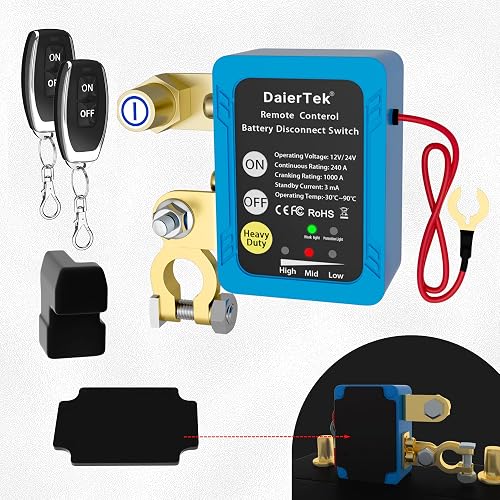 |  |  |  |  |  |  |  | 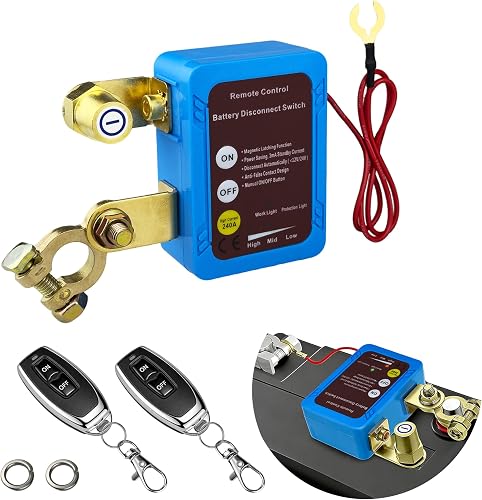 |
|---|---|---|---|---|---|---|---|---|---|---|
| Product | Remote Battery Disconnect Switch 12V | DaierTek Remote Battery Disconnect | 250A Smart Remote Disconnect | 12V/24V 240A Remote Disconnect | Pure Copper 1000A Remote Disconnect | 240A Remote Disconnect LED | 12V APP Control Disconnect | 200A Remote Battery Kill Switch | 250A Remote Disconnect Marine | Smart Remote Disconnect 240A |
| Brand | DZSSCY | DAIERTEK | Ponzkoe | Fyssqzh | Art Vagon | MaySpare | RIEIEK | FENGWANGLI | LSZQJ | Tallsocne |
| Best for | Best Overall | Best for 24V Rigs | Best for Parked Vehicles | — | Best for Cold Starts | Best for Wet Conditions | Best for Phone Control | — | Best for Marine Use | Best for No-Drill Mounting |
| The listing says | Remote switch stops battery drain and protects circuit Rated current up to 250A, instantaneous current up to 450A | Works with both 12V and 24V systems Chip detects voltage and enters matching mode | Keychain remote cuts power instantly, rated 250A Remote and manual ON/OFF button, 5 green LEDs | Two wireless remote fobs reduce theft risk Rated 240A continuous at 12V, up to 500A instant | Fits most 12V-24V gasoline vehicles under 4.0L Works with 9-13 mm and 15-17 mm negative terminals | Cuts power after 120s below 11.8V Remote disabled above 13.2V | Fits 12V-24V systems, input 6V to 30V Standby current only 0.6mA at 12V input | Remote switch stops battery drain and protects circuit Cuts power after 120s below 11.8V | Prevents discharge from long-term parking, aging circuits, forgotten lights Handles loads up to 250A, standby drain only 1mA | Handles 12-24V systems, rated 240A, 500A surge Brass body, silver contacts, pure copper wires |
| More information | Check Price on Amazon | Check Price on Amazon | Check Price on Amazon | Check Price on Amazon | Check Price on Amazon | Check Price on Amazon | Check Price on Amazon | Check Price on Amazon | Check Price on Amazon | Check Price on Amazon |
1. Remote Battery Disconnect Switch 12V
Best for: The first-time buyer on a 12V car
This is the plainest version of the idea. A remote cuts the negative side of the battery, and the listing rates it at 250A continuous with 450A instantaneous — enough for a normal car or light truck starter. The seller says the module uses copper wire and a larger receiver for better range.
The install note matters more than the spec sheet. You fix the battery clip to the negative pole and run the red wire to the positive pole, and the seller says this version dropped a black power cord to make that simpler. There’s a warning worth reading twice: disconnecting the positive terminal instead can damage the battery and the vehicle circuit, so follow the negative-side instruction exactly.
It fits cars, trucks, RVs, travel trailers, campers and motorcycles on 12V. The listing names 12V vehicles only, so a buyer mounting it in an open engine bay on a boat should look at the marine pick instead. The seller offers after-sales contact with a 24-hour reply window.
Pros
- 250A rated, 450A instantaneous current
- Simple negative-terminal install, one wire fewer
- Fits cars, trucks, RVs, campers, motorcycles
Cons
- Listed for 12V systems only
2. DaierTek Remote Battery Disconnect Switch 12V/24V 240A Kill Switch Automotive
Best for: Truck, RV and boat owners on 12V or 24V
DaierTek’s switch reads the supply itself. Connect it and the chip decides whether it’s running a 12V or 24V system, and it holds that mode until you cut power and start again. That’s the feature that makes it the pick for a mixed fleet or a 24V rig.
The safety logic is the interesting part. Below 11.8V on 12V (or 23V on 24V), and above 13.2V (or 25V), the remote stops working and a protection light comes on. The idea is to stop an accidental press during ignition or driving. You can still work the switch by hand, which is a real difference from units that lock you out entirely.
It also watches voltage out loud: a low indicator and a 60-second alarm below 11.8V, a mid light in the normal band, a high light above 13.3V. If low voltage lasts more than two minutes, it cuts power on its own. It comes with a battery clamp and connect stud, and the seller says no existing wires need cutting.
Pros
- Auto-detects 12V or 24V on connection
- Manual button works when remote is locked out
- Low-voltage alarm and auto shut-off
Cons
- Indicator lights and alarm are always active
- Voltage mode resets only on full power cycle
3. 250A Smart Remote Battery Disconnect Switch 12V 24V
Best for: Vehicles that sit parked for weeks
Standby draw is the number that matters when a car sits, and this listing states 0.7mA — against the 65mA it says a factory vehicle circuit pulls. Over a long park, that gap is the whole point of fitting one.
The remote gives one-click cutoff for theft and parasitic drain, and there’s a manual ON/OFF button alongside it. Five green LEDs confirm each action, so you’re not guessing whether the truck is isolated. The seller tells you to extend the black spring-shaped antenna for better range, which is a setup step people skip.
Read the fitment warning before ordering: it only fits tapered posts in the 15-17mm range, and the seller caps it with “don’t use on industrial equipment.” It’s aimed at cars, RVs, trucks, trailers, ATVs and marine boats on 12V or 24V. In smart mode the remote disables below 11.4V, and between 6.5V and 11V you’re on the manual button only.
Pros
- 0.7mA standby draw, stated in the listing
- Remote plus manual ON/OFF control
- Five LEDs confirm every action
Cons
- Only fits 15-17mm tapered posts
- Not for industrial equipment
4. 12V/24V 240A Remote Battery Disconnect Switch
Best for: Buyers who want a flame-retardant housing
Two remote fobs come in the box here, which is the practical difference — one for the keychain, one for the house or the glovebox. The listing rates the switch at 240A continuous and up to 500A instant, with 3mA standby.
The protection logic runs on two thresholds. Below 11.8V (or 23V), it sounds an alarm after 60 seconds, then cuts power after 120 seconds to stop over-discharge. Above 13.7V (or 26.3V), the remote disables and you have to work it by hand — that’s the guard against a stray press while driving or charging. An LED voltmeter shows live voltage, so you can watch the battery rather than guess at it.
The housing is described as flame-retardant, and the seller lists cars, trucks, boats, RVs and motorcycles on 12V. The install is a negative-terminal connection with the power off first. Anyone running a 24V system should check the dual-voltage picks above, since this one’s fitment line names 12V vehicles.
Pros
- Two remote fobs included
- LED voltmeter shows live voltage
- 240A continuous, 500A instant rating
Cons
- Fitment line names 12V vehicles
- Remote disabled above the high threshold
5. 12V/24V 240A-1000A Pure Copper Conductive Remote Battery Disconnect Switch
Best for: Big engines and cold-climate starts
The headline figure is the surge rating: 240A continuous, up to 1000A surge, with a stated 0.2-second response. On a large gasoline engine where inrush current is the hard part, that headroom is what you’re buying.
It covers 12V and 24V gasoline vehicles under 4.0L, and works with both 9-13mm and 15-17mm negative terminals — the two common post sizes. The seller asks you to measure your terminal before ordering, which is the right habit for any of these. An LED display shows live voltage and battery health.
The protection window is 11.8V to 13.2V: below it, power cuts after a short delay; above it, the remote disables so you can’t kill the car while driving or charging. The kit includes the switch, a pair of remotes and a manual, and the seller runs its own after-sales support. The listing names gasoline vehicles under 4.0L.
Pros
- 240A rated, 1000A surge, 0.2s response
- Fits 9-13mm and 15-17mm terminals
- Two remotes and manual included
Cons
- Listed for gasoline engines under 4.0L
- Terminal size must be measured first
6. 240A Remote Battery Disconnect Switch 12V
Best for: Marine and off-road use in wet conditions
This is the one listing here that states a sealed, dust- and spray-resistant rating, which is the fact that decides it for a boat, a trailer or an off-road rig that sees spray and dust. The relay is rated 240A and the pillars are pure copper, which the seller says resists rust.
Range is quoted at 100 meters (328 feet), and the seller says it works through walls and enclosures — useful when the switch is buried in a battery box. The LED digital display tracks voltage in real time, so you can read the battery without lifting the hood.
The protection behaves like the others: power cuts after 120 seconds below 11.8V, and the remote disables above 13.2V to stop an accidental shutdown while driving. Install uses the negative link method, which keeps your original wiring intact and is reversible. It fits 9-13mm and 15-17mm negative posts, and the seller warns it won’t work on small or non-standard post heads.
Pros
- IP54 waterproof casing stated
- 328ft remote range, works through walls
- Reversible negative-pole install
Cons
- Not for small or non-standard posts
- Optimized for 12V under 4.0L
7. 12V Universal Remote & APP Control Battery Disconnect Switch
Best for: Drivers who want phone control
This one adds Bluetooth. You can power up by remote or by proximity — the switch connects automatically when your phone gets close — and you can adjust the low-voltage cutoff point in the app. That adjustability is the real difference; the others fix their threshold.
The hardware matches the ambition: 320A rated, 860A instantaneous surge, and a standby draw of 0.6mA at 12V. The seller describes a motor-driven relay with a dual-contact structure for vibration resistance, and a color screen showing voltage and switch state. Power-off is locked when voltage is above 13.7V (or 27.4V) or when vehicle vibration is detected, which is a second guard against a shutdown while moving.
The kit includes a wrench, gloves and mounting tape. One limit is stated plainly: the included clamp and terminal fit a 0.66-inch negative post only, and other sizes or the positive pole need extra parts. It’s aimed at sedans, pickups and SUVs on 12V to 24V systems.
Pros
- App control with adjustable cutoff
- 320A rated, 860A surge, 0.6mA standby
- Color screen shows voltage and status
Cons
- Included clamp fits 0.66in post only
- App needed for cutoff adjustments
8. 200A Remote Battery Kill Switch
Best for: Simple installs on smaller 12V vehicles
The install story is the selling point. The seller says this version dropped a black power cord, so you fix the clip to the negative pole and run one red wire to the positive — fewer steps than a typical unit. It uses a mechanical magnetic switch with a stated standby current of 0.003A.
The electrical numbers are lower than the rest: 200A rated, 360A starting current. The listing names cars, SUVs, ATVs and UTVs along with trucks, RVs, travel trailers, campers, vans and boats. On a big-block truck or a diesel, the lower rating is the thing to weigh before buying.
Protection follows the familiar pattern — auto cut-off after 120 seconds below 11.8V, remote disabled above 13.2V while driving. There’s no voltage display and no waterproof rating in the listing, so a buyer who wants to read the battery at a glance should look at the LED models instead. It’s a straightforward switch for a straightforward vehicle.
Pros
- 200A rated, 360A starting current
- 0.003A standby, stated by seller
- One-wire install, no black cord
Cons
- Lower current rating than other picks
- No voltage display listed
9. 250A Remote Battery Disconnect Switch 12V
Best for: Tight engine bays and mixed mounting angles
Mounting flexibility is what sets this apart. The kit includes metal plates so you can set it vertically or horizontally, and the body measures 3.3 x 2.4 x 1.4 inches — small enough for a crowded bay. It works with top post and side post batteries, per the listing.
The switch carries up to 250A through magnetic relays, with a standby draw of 1mA. An LED voltage display shows battery health, and the logic matches the family: auto shut-off 120 seconds below 11.8V, remote disabled above 13.6V to prevent a power loss while driving. You can work it by the button or the remote.
It’s listed for 12V systems on cars, boats, RVs, trailers, trucks, ATVs, UTVs and motorcycles, with a stated limit of vehicles under 3.0L. It supports negative polarity on 9-13mm and 15-17mm posts. A buyer with a larger engine should check the higher-rated picks above.
Pros
- Vertical or horizontal mounting plates
- 250A capacity, 1mA standby
- Fits top post and side post batteries
Cons
- Listed for vehicles under 3.0L
- Negative polarity only
10. 12V/24V 240A Smart Remote Battery Disconnect Switch
Best for: Quick, no-drill mounting under the hood
Flat mounting is the whole idea here — the seller says no drilling and no hood work, and everything needed is in the box. You mount it flat, keep the remote in the glovebox or your pocket, and switch power from inside the cab.
The specs are competitive: 240A rated, 500A surge, and 12V to 24V coverage for cars, trucks, RVs, boats and motorcycles. The body is solid brass with silver contacts and pure copper wires, and the remote runs on a standard CR2023 battery. That last detail is a small thing that matters years in, when the fob needs a fresh cell.
The protection window is a bit different: below 12V, it cuts power after three minutes rather than two. That’s a slightly longer wait before the switch acts, which is worth knowing if you’re buying it mainly for deep-drain protection on a vehicle that sits. It’s aimed at the buyer who wants the job done in an afternoon.
Pros
- Flat mount, no drilling needed
- 240A rated, 500A surge
- Remote uses standard CR2023 battery
Cons
- Three-minute delay before auto cut-off
Also Worth Considering
Off Switch Remote Control Switch — a 12V 240A remote disconnect for auto, car, truck and boat use. The title names the same core job as the picks above, so it belongs in the same shortlist if you’re comparing options.
Remote Battery Disconnect Switch — a 12V 240A unit with a protect cover over the switch, which could suit a buyer who wants the terminals shielded. It lists anti-theft and drain prevention for auto, RV and truck.
Remote 12V/24V Switch Kill Switch — a 12V/24V 240A disconnect with voltage protection in the title. Worth a look if you run a 24V system and want another dual-voltage option to weigh.
How to Choose in Sixty Seconds
What current rating do I actually need?
Match the rating to your engine, not to the biggest number on the page. A 200A-rated switch with 360A starting current is listed for cars, SUVs, ATVs and UTVs, and that covers most daily drivers. Step up to 240A or 250A if you tow, run a truck, or want headroom for a cold start. The Pure Copper 1000A Remote Disconnect goes further with a 1000A surge rating for gasoline engines under 4.0L. Whatever you pick, the continuous rating is the one that matters for running loads — the surge figure only covers the brief moment of cranking.
Will it fit my battery post?
Measure first. These switches clamp to the negative post, and the listings give exact sizes: the 250A Smart Remote Disconnect fits only 15-17mm tapered posts, while the Pure Copper 1000A Remote Disconnect and the 240A Remote Disconnect LED both cover 9-13mm and 15-17mm. The 12V APP Control Disconnect is narrower still — its included clamp fits a 0.66-inch post, and other sizes need extra parts. A clamp that won’t close is useless, so a tape measure before ordering is worth the minute.
Do I need 12V or 24V?
Only you know your system, but the difference changes which switch works. The DaierTek Remote Battery Disconnect reads the supply itself and enters the matching mode, holding it until you cut power. The 250A Smart Remote Disconnect, the 12V/24V 240A Remote Disconnect and the Smart Remote Disconnect 240A all list dual-voltage coverage. If you’re on 12V only, the Remote Battery Disconnect Switch 12V and the 200A Remote Battery Kill Switch are built for that alone. Getting this wrong means the protection thresholds land in the wrong place.
Frequently Asked Questions
What does a remote kill switch need from my vehicle?
It needs a 12V or 24V battery, a negative post in the size the listing states, and enough space to mount the module. The Pure Copper 1000A Remote Disconnect covers gasoline vehicles under 4.0L with 9-13mm or 15-17mm terminals. Most units wire to the negative side, and disconnecting the positive terminal instead can damage the battery and circuit.
What goes wrong first?
The connection, not the electronics. The 250A Smart Remote Disconnect tells buyers to make sure all screws are tightly tightened, and the 12V/24V 240A Remote Disconnect asks you to disconnect power before installing. The 250A Smart Remote Disconnect also warns against disassembling the unit, since that can damage the circuit board. Start with the terminals and work outward.
Is the simplest switch on the list enough?
For a stock 12V car or light truck, yes. The 200A Remote Battery Kill Switch is rated 200A with 360A starting current, uses a mechanical magnetic switch with a stated 0.003A standby draw, and the seller says it installs with one red wire. The listing names cars, SUVs, ATVs and UTVs on 12V.
Closing
For most buyers, the Remote Battery Disconnect Switch 12V is the one to start with — it’s rated for the job, it wires to the negative terminal with one fewer cord, and the seller spells out the install. If you run a truck, RV or a 24V system, the DaierTek Remote Battery Disconnect earns its place by reading the voltage itself and locking the remote out when it should. Next step: measure your battery post and note your system voltage, then check those two numbers against the listing before you order.
Related posts:
 7 Best Portable Air Compressor for Car Tires: Top Picks Reviewed
 Best All Terrain Truck Tires for Towing: Ultimate Durability and Performance
 5 Best Tire Inflator for Truck Tires: Top Heavy-Duty Picks for 2025
 Best Fuel Tank Cleaner for Removing Sludge and Varnish Efficiently
 Best Gas Fuel Injector Cleaner: Top Picks to Boost Engine Performance
 Best Brake Pads for Trucks: Top Picks for Heavy-Duty Performance
 Best Automotive Air Compressor: Top 5 Tire Inflators for Your Vehicle
 Best Automotive Buffer for Flawless Car Detailing and Polishing
 Best Automotive Bug And Tar Remover: Top 5 Picks for Spotless Cars
 Best Automotive Water Spot Remover for Cars, Trucks, RVs & More