
There’s no single best remote kill switch for car. There’s a best one for your battery, your parking habits, and how often you actually drive. Three things decide it: whether your battery posts match the clamp the switch ships with, whether your vehicle runs 12V or 24V, and how many amps your starter pulls on a cold morning. These switches differ on those points, not on rank. They also split on how they cut power — most break the negative cable, one works on the positive post. If you park for weeks at a time, look at the DZSSCY Remote Battery Disconnect Switch 12V. If you drive a truck, RV or boat and want voltage protection built in, look at the DaierTek 240A Kill Switch.
All 10 products side by side — scroll sideways to see every column.
| Top Pick | Best for 24V Systems | Best for Spare Remote | Best for First-Time Buyers | Best for Long Range | Best for Marine Use | Best for Big Engines | Best for Phone Control | |||
| Preview |  | 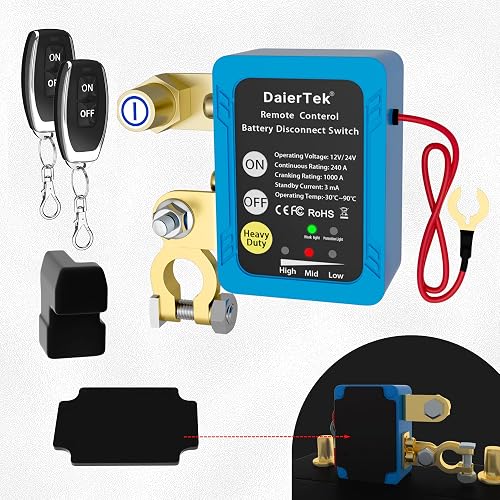 |  | 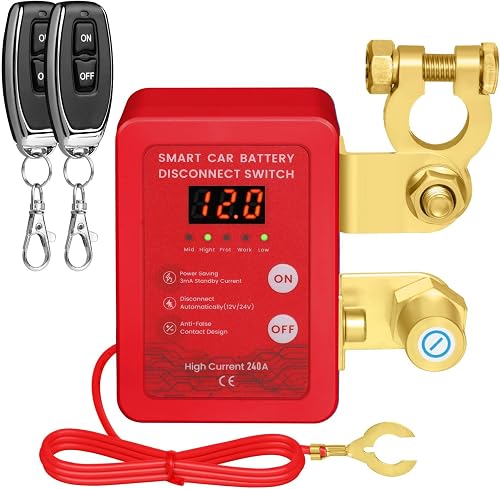 |  |  |  |  |  |  |
|---|---|---|---|---|---|---|---|---|---|---|
| Product | Remote Battery Disconnect Switch 12V | DaierTek 240A Kill Switch | 240A Smart Voltage Kill Switch | 240A LED Screen Kill Switch | 250A Smart Kill Switch | 200A Remote Kill Switch | 240A Dual Remote Kill Switch | 300A Wireless Kill Switch | 12V App Control Kill Switch | Remote Battery Kill Switch 200A |
| Brand | DZSSCY | DAIERTEK | Fyssqzh | Lizekm | Ponzkoe | FENGWANGLI | MaySpare | RVMARINEPAT | RIEIEK | FEITON |
| Best for | Best Overall | Best for 24V Systems | Best for Spare Remote | Best for First-Time Buyers | Best for Long Range | — | Best for Marine Use | Best for Big Engines | Best for Phone Control | — |
| The listing says | Stops battery drain while parked Rated current up to 250A, instant 450A | Works with both 12V and 24V systems Remote disabled below DC11.8V/23V or above DC13.2V/25V | Includes two wireless remote fobs Rated 240A continuous at 12V, up to 500A instant | Cuts power after 120s below 11.8V Remote disabled above 13.2V | Upgraded heavy duty 250A Remote and manual ON/OFF button | Stops battery drain while parked Connects to negative pole, red wire to positive | Cuts power after 120s below 11.8V Remote disabled above 13.2V | Isolates power at the positive terminal 300A continuous and 1000A cranking capacity | Fits 12V-24V systems, input 6V to 30V Standby current only 0.6mA at 12V | Connect red wire to positive pole Fix battery clip to negative pole |
| More information | Check Price on Amazon | Check Price on Amazon | Check Price on Amazon | Check Price on Amazon | Check Price on Amazon | Check Price on Amazon | Check Price on Amazon | Check Price on Amazon | Check Price on Amazon | Check Price on Amazon |
1. Remote Battery Disconnect Switch 12V
Best for: Daily drivers that sit parked for weeks at a time
This switch is built for the person whose car sits in a lot or driveway for long stretches and comes back to a flat battery. It cuts the negative side, so the install is one clamp on the negative post and one red wire to the positive. The listing says the upgraded version drops a black power cord, which means fewer connections to get wrong on a first install.
The listed numbers are 450A instantaneous and 250A rated, with pure copper wire and a larger receiver module for better remote reception. That 250A rating is the one to check against your own starter’s draw. The listing also says it can extend battery life by 3 to 4 times, which is the seller’s claim, not a measured figure.
It covers cars, trucks, RVs, travel trailers, campers and motorcycles — anything on a 12-volt battery. The listing warns that disconnecting the positive terminal may damage the battery and vehicle circuit, so this one goes on the negative side only. Support runs by email with a stated 24-hour reply.
Good if:
- You leave a car parked for weeks and keep coming back to a dead battery
- You want a negative-side install without cutting existing wires
- You drive a 12V car, truck, RV or camper
Skip it if:
- You run a 24V system — this one is listed for 12V only
- Your vehicle’s starting draw sits well above the 250A rated current
2. DaierTek Remote Battery Disconnect Switch 12V/24V 240A Kill Switch Automotive
Best for: Truck, RV and boat owners who want voltage protection
This one is for the owner of a bigger vehicle who wants the switch to think for itself. It handles both 12V and 24V, and a chip inside reads the supply and picks the matching mode.
The protection logic is the real story. Below 11.8V or 23V the remote is disabled and the protection light comes on, so nobody triggers it by accident during ignition. In the normal range the Mid indicator stays lit. Above 13.3V or 25V the High indicator lights. If the battery sits low for more than two minutes, the switch cuts power on its own to stop the drain.
Installation uses a battery clamp and connect stud, with no cutting of existing wires. The listing asks you to power down before installing and run an ignition test afterward. It fits most cars, boats, RVs, trailers, trucks, ATVs, UTVs and motorcycles, and the manual button still works when the remote is locked out.
Good if:
- You own both a 12V and a 24V vehicle and want a single switch that handles either
- You want the switch to shut off power by itself when the battery runs low
- You’d rather not cut into existing wiring
Skip it if:
- You want a plain on/off remote with no voltage logic to learn
- You only ever park for a day or two at a time
3. 12V/24V 240A Remote Battery Disconnect Switch
Best for: Buyers who want a second remote as a spare
Two wireless fobs come in the box here, which suits anyone who’s lost a remote before or wants one on each set of keys. The listing puts it at 240A continuous on 12V, with up to 500A instant current and 3mA standby draw.
It cuts power to stop drain from long parking, self-discharge, lights left on, or aging wiring. The thresholds are listed at 11.8V±0.2V for the power-off point. Below 11.8V or 23V an alarm sounds after a 60-second delay, then the switch cuts power after 120 seconds. Above 13.7V or 26.3V the remote is disabled and you use the manual control instead.
An LED voltmeter shows live voltage, so you can watch the battery rather than guess at it. The casing is listed as flame-retardant. Installation is on the negative terminal, with the listing asking you to disconnect power first. It’s listed for 12V vehicles — cars, trucks, boats, RVs and motorcycles — and the 240A rating is the ceiling to check against your own starter.
Good if:
- You want a backup remote included rather than purchased on its own
- You like seeing live voltage on the unit itself
- You want an audible warning before the power cuts
Skip it if:
- You run a 24V system — this listing is written around 12V
- You want no alarm tone near where the vehicle is parked
4. Kill Switch for Car – Remote Battery Disconnect Switch 12v
Best for: First-time buyers who want a simple, complete kit
This is the straightforward pick for someone who has never fitted a kill switch and wants a complete kit. The listing includes the cut-off switch, two remote controllers, a manual, a nut and a gold spacer — nothing else to source before you start.
The behavior is simple. Below 11.8V it cuts power after 120 seconds to save the battery. Above 13.2V the remote is disabled so you can’t kill power while driving, and only the button on the switch works. It’s listed as a mechanical magnetic switch with 3mA standby current, which the listing frames as the fix for parking drain.
It fits most 12V cars, boats, RVs, trailers, trucks, ATVs, UTVs and motorcycles with a rated battery current under 240A. That “under 240A” line is the one to check before buying. The stated job is preventing drain from long parking, aging wiring and lights left on.
Good if:
- You’re fitting a kill switch for the first time and want the full kit
- You want a pair of remotes included from the start
- You drive a 12V vehicle with a rated current under 240A
Skip it if:
- Your vehicle’s rated battery current goes above 240A
- You want a 24V option — this listing is 12V
5. 250A Smart Remote Battery Disconnect Switch 12V 24V
Best for: Owners who want the remote to reach across a big lot
This one suits someone who parks far from where they stand — a large lot, a storage yard, a driveway where the car sits well away from the house. The listing tells you to extend the external black spring-shaped antenna for more remote distance, which is the lever for exactly that.
The listed numbers are 250A heavy duty, 0.7mA standby current, and 5 bright green LEDs that confirm each action so you know the state of the switch. It runs remote and manual modes. In smart mode the remote is disabled below 11.4V to stop accidental shutdowns, and it works normally between 11.4-14V or 23-27V. Below 6.5V the device won’t function at all, and between 6.5V and 11V you use the manual button only.
The listing carries hard warnings worth reading twice: tighten all screws securely, it only fits post diameters of 15-17mm tapered, and it must not go on industrial equipment. It’s built from copper with an anti-false-contact design.
Good if:
- You park a long way from where you keep the remote
- You want LED confirmation that the power is actually cut
- Your battery posts measure 15-17mm tapered
Skip it if:
- Your battery posts fall outside the 15-17mm tapered range
- You want to use it on industrial equipment — the listing says not to
6. Remote Battery Disconnect Switch 12V
Best for: Someone who wants the simplest possible install
This is for the buyer who wants the fewest steps and the least fuss. It cuts the negative side, clamps to the negative post, and runs one red wire to the positive. The listing says the upgraded version drops a black power cord, so there’s less to route than on older designs.
The listed ratings are 200A rated current and 360A starting current, with 0.003A standby on a mechanical magnetic switch — the same 3mA figure other listings here quote. Below 11.8V it cuts power after 120 seconds. Above 13.2V the remote is disabled while driving so a bump in your pocket can’t kill the engine.
It’s listed for a wide range of 12V vehicles: cars, trucks, RVs, travel trailers, campers, SUVs, ATVs, UTVs, marine, vans and boats. The 200A rated figure is the lowest ceiling in this group, so it’s the number to check against your own starter.
Good if:
- You want a short, simple negative-side install
- You drive a 12V car, SUV, van or ATV
- You don’t need voltage readouts or alarms
Skip it if:
- Your starter draws well above the 200A rated current
- You want a display or warning tones on the unit
7. 240A Remote Battery Disconnect Switch 12V
Best for: Marine and off-road owners who face water and dust
This pick is aimed at someone whose vehicle lives outdoors — a boat, an off-roader, anything that meets spray and grit. The casing is listed IP54 waterproof, and the copper pillars are solid with a stated zero-rust build. That pairing is what the listing offers for wet or dusty conditions.
The remote range is listed at up to 100 meters, or 328 feet, and the listing says it works through walls and enclosures. An LED digital display tracks voltage live. The voltage logic cuts power after 120 seconds below 11.8V, and disables the remote above 13.2V so you can’t shut down while driving.
Installation uses a negative link method that preserves your original wiring, and it’s listed as reversible. It fits standard negative poles at 9-13mm or 15-17mm, and it’s optimized for 12V vehicles with displacements under 4.0L and rated currents up to 240A. The listing notes it isn’t compatible with small or non-standard battery post heads.
Good if:
- Your vehicle sits outside in spray, dust or weather
- You want a long remote range and a live voltage display
- Your engine is under 4.0L and your posts are 9-13mm or 15-17mm
Skip it if:
- Your battery posts are small or non-standard
- Your engine displacement is above 4.0L
8. 300A Positive Terminal Remote Battery Disconnect Switch
Best for: Big engines and winter storage on the positive post
This one is for the owner of a large engine who wants the highest current rating listed here, and who is willing to work on the positive terminal instead of the negative. The listing says it isolates power at the positive terminal for complete electrical isolation, and it frames that as the difference from the negative-cut switches most people buy.
The listed capacity is 300A continuous and 1000A cranking, with molded pure copper-wrapped clamps. Adjustable terminal adapters are included so the clamp fits oversized and undersized posts without snapping. It reads both 12V and 24V through a self-adaptive chip. Below 11.8V or 23V for more than 120 seconds, it cuts power on its own. Above 13.2V or 25V the key fob is disabled while driving, and the onboard manual buttons still work.
A 3-color LED display shows voltage and health, and two 433MHz mini key fobs work from up to 328 feet. If your vehicle’s starting draw is the thing you worry about, the 1000A cranking figure is the number to weigh.
Good if:
- You run a large engine and want the highest listed cranking capacity
- You want positive-terminal isolation rather than a negative cut
- You want manual override buttons that stay live at all times
Skip it if:
- You’d rather not work on the positive terminal
- You want a plain negative-side install with fewer steps
9. 12V Universal Remote & APP Control Battery Disconnect Switch
Best for: Buyers who want phone control and proximity unlock
This is the pick for someone who wants the switch to work without reaching for a fob. It runs on remote or by Bluetooth proximity, so the power reconnects as you approach. The listing puts it at 320A rated and 860A instantaneous surge, with 0.6mA standby at 12V input.
The protection thresholds are adjustable in the app for 12V or 24V. Below your preset value it cuts power to stop over-discharging. Above 13.7V or 27.4V, or when vehicle vibration is detected, disconnection is locked so you can’t cut power while driving. A color screen shows voltage and switch state in real time.
The relay is motor-driven with a dual-contact structure, listed for vibration resistance so contacts don’t loosen. Cables are flexible red copper silicone for tight spaces, the shell is flame-retardant, and the operating range is listed at -31°F to 203°F. The kit includes a wrench, gloves and EVA tape. The included clamp fits a 0.66 inch negative post only — other sizes or the positive pole need extra parts.
Good if:
- You want app control and automatic reconnect as you walk up
- You want to set your own low-voltage cutoff point
- You drive a sedan, pickup or SUV on a 12V system
Skip it if:
- Your negative post isn’t 0.66 inch and you don’t want to buy extra clamps
- You’d rather not depend on a phone app to start your car
10. Remote Battery Disconnect Switch 12V Battery Kill Switch
Best for: Buyers who want to keep the original negative cable
This one suits someone who doesn’t want to disturb the car’s factory wiring any more than needed. The listing says the black negative wire is already fitted at the bottom of the switch, and it connects to your original negative wire. That’s a different install path from the clamp-on designs.
The listed ratings are 200A on 12V DC with 360A starting current, silver contacts and pure copper wires, with all wiring harnesses included. The listing says the improved fittings make the mounting contacts stronger than the older model. It works across cars, trucks, RVs, travel trailers, campers, SUVs, ATVs, UTVs, marine, vans, boats and agricultural vehicles on 12V.
Two notes in the listing are worth reading before you buy. On some vehicles you need to wait about 6 seconds after reconnecting before pressing the start switch. And if your stereo doesn’t fully power down, it may need re-matching once you cut the battery. The listing itself points buyers who mind the wiring change toward a 250A upgrade model instead.
Good if:
- You want to keep your original negative cable in place
- You drive a 12V car, truck, RV or camper
- You’re fine waiting a few seconds after reconnect before starting
Skip it if:
- Your stereo loses its settings when the battery is cut and that bothers you
- You need a 24V option
Where These Overlap
Several of these are close enough that the choice barely matters. The 240A Smart Voltage Kill Switch, the 240A LED Screen Kill Switch, the 200A Remote Kill Switch and the Remote Battery Kill Switch 200A all cut the negative side, all list the same 11.8V cutoff with a 120-second delay, and all disable the remote above roughly 13.2V. If your vehicle is a 12V car or small truck, any of those four does the same job, and the deciding factor is the kit contents — the LED Screen model ships two remotes and a full set of hardware, which settles it for a first-timer.
The real splits are elsewhere. The DaierTek 240A Kill Switch reads 12V and 24V through a chip and shows Low, Mid and High voltage states. The 300A Wireless Kill Switch isolates the positive terminal and quotes 1000A cranking. The 12V App Control Kill Switch is the one with Bluetooth proximity and an app-adjustable cutoff. Those three aren’t variations on each other — they’re answers to different questions, and the listed ratings and install methods are what separate them.
Still Not Sure?
Will I actually use this, or will it sit in a drawer?
That depends on how long your vehicle sits. If it’s a daily driver that moves every morning, a kill switch earns its place mainly as anti-theft — you cut power when you park somewhere you don’t trust. If it’s a weekend car, a boat or a camper that sits for weeks, the drain protection is the point, and the automatic cutoff below 11.8V does the work whether you remember or not. Be honest about which one you are. For the long-parking case, the DZSSCY Remote Battery Disconnect Switch 12V is built around exactly that job.
Will it fit my battery and my vehicle?
Two measurements decide this, and both are in the listings. First, the post: the 250A Smart Kill Switch fits 15-17mm tapered posts only, the 240A Dual Remote Kill Switch fits 9-13mm or 15-17mm, and the 12V App Control Kill Switch fits a 0.66 inch negative post only. Second, the current: the 200A Remote Kill Switch is rated at 200A, the 300A Wireless Kill Switch at 300A continuous. If your vehicle runs 24V, check both numbers before anything else — the DaierTek 240A Kill Switch covers the 24V side.
What am I most likely to regret?
Usually one of two things. The first is a stereo or head unit that loses its memory every time you cut the battery — the Remote Battery Kill Switch 200A listing says outright that some stereos need re-matching after a disconnect. The second is buying a switch that can’t handle your starter on a cold morning, which is why the rated current matters more than the remote range. If neither worry applies and you just want the strongest listed capacity, the 300A Wireless Kill Switch quotes 1000A cranking.
Frequently Asked Questions
Does a remote car kill switch drain the battery itself?
No — the standby draw is tiny, and every listing here quotes it. The 240A LED Screen Kill Switch lists 3mA standby. The 250A Smart Kill Switch lists 0.7mA and points out that the vehicle’s own electronics pull far more than that. So the switch draws a fraction of what the car’s own systems draw while parked.
Can I install a remote battery disconnect switch myself?
Yes, and none of these listings require cutting factory wires on the negative-side models. The Remote Battery Disconnect Switch 12V and the 200A Remote Kill Switch both describe clamping to the negative post and running one red wire to the positive. Several listings ask you to disconnect power before you start.
Will the remote work while I’m driving?
No, and that’s deliberate. Above roughly 13.2V the remote is disabled so a fob in your pocket can’t cut the engine. The DaierTek 240A Kill Switch disables the remote below 11.8V or 23V and above 13.2V or 25V. The 300A Wireless Kill Switch disables the fob above 13.2V or 25V. On all of them, the manual button still works if you need it.
What’s the difference between a negative and a positive kill switch?
Yes. Most of these cut the negative cable, including the Remote Battery Disconnect Switch 12V and the 240A LED Screen Kill Switch. The Remote Battery Disconnect Switch 12V listing warns that disconnecting the positive terminal may damage the battery and vehicle circuit, so follow the install method each product specifies.
Conclusion
Before you buy, measure your battery post and check your starter’s cold-cranking amps, then match those to the switch’s clamp and rating. If you’re unsure, ask the seller directly — it’ll save you a return. Pick the one that fits your setup, not the one with the loudest listing.
Related posts:
 7 Best Portable Air Compressor for Car Tires: Top Picks Reviewed
 Best All Terrain Truck Tires for Towing: Ultimate Durability and Performance
 5 Best Tire Inflator for Truck Tires: Top Heavy-Duty Picks for 2025
 Best Fuel Tank Cleaner for Removing Sludge and Varnish Efficiently
 Best Gas Fuel Injector Cleaner: Top Picks to Boost Engine Performance
 Best Brake Pads for Trucks: Top Picks for Heavy-Duty Performance
 Best Automotive Air Compressor: Top 5 Tire Inflators for Your Vehicle
 Best Automotive Buffer for Flawless Car Detailing and Polishing
 Best Automotive Bug And Tar Remover: Top 5 Picks for Spotless Cars
 Best Automotive Water Spot Remover for Cars, Trucks, RVs & More