
Choosing a tire gauge with a braided hose comes down to whether you need a simple tool for quick checks or a heavy-duty inflator for regular maintenance. The main difference is the internal mechanism—analog gauges work without batteries, while digital models offer precise, backlit readings.
Best overall: Rhino USA Tire Gauge features a 3-in-1 design that lets you inflate, check, and bleed air using a single connection, making it highly efficient for garage or roadside work.
Best for off-roaders: ARB Digital Tire Gauge offers a large, backlit screen and a high-flow design, which helps when you need to adjust pressures quickly during off-road adventures.
Best for simplicity: Milton Dial Tire Gauge uses a reliable bourdon tube movement that stays accurate regardless of temperature changes, providing a straightforward experience for the everyday driver.
This guide is for anyone looking to maintain their vehicle tires properly without the frustration of stiff hoses.
How We Picked
We compared 95 different Amazon listings to find the best tire pressure gauges with braided hoses. To earn a spot, a product had to clearly state its pressure range, hose length, and the type of chuck connection it uses. We prioritized tools that included professional-grade features like bleed valves and solid brass fittings. Products were removed from consideration if they lacked basic technical specifications or provided conflicting information regarding their intended use.
All 10 products side by side — scroll sideways to see every column.
| Top Pick | Best for Off-Roading | Best for Low Light | Best for Battery-Free | Best for Precision | Best for Heavy Trucks | Best for Simple Use | Best for Roadside | |||
| Preview |  |  |  |  |  |  |  | 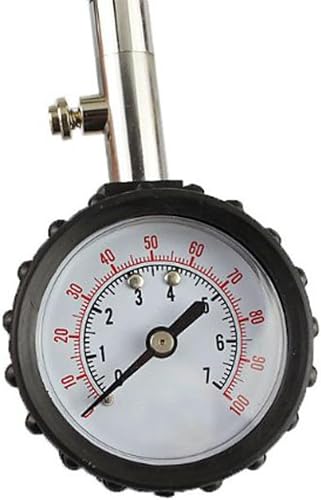 |  |  |
|---|---|---|---|---|---|---|---|---|---|---|
| Product | Rhino USA Tire Gauge | ARB Digital Tire Gauge | Rhino USA Digital Gauge | Milton Dial Tire Gauge | Digital Tire Inflator Gauge | AstroAI Digital Inflator | DEWALT Digital Inflator | Metal Rubber Tire Gauge | Brass Rubber Analog Gauge | Milton Braided Hose Gauge |
| Brand | Rhino USA | ARB | Rhino USA | Accu-Gage | AZUNO | AstroAI | DEWALT | BUGUUYO | LeeQinersw | Accu-Gage |
| Best for | Best Overall | Best for Off-Roading | Best for Low Light | Best for Battery-Free | Best for Precision | Best for Heavy Trucks | — | Best for Simple Use | Best for Roadside | — |
| The listing says | Inflates, checks, and bleeds air No-battery analog design | Nickel-plated brass and braided hose Large LCD with blue backlight | Metal braided hose and brass swivel Heavy duty air bleeder valve | Bourdon tube movement for durability No batteries required | Braided stainless steel hose Smart LCD with 4 units | ANSI B40.7 Grade 2A accuracy Measures PSI, Bar, kPa, kg/cm² | 2.5" digital inflator with 12" hose | Swivel angle chuck 0-100 psi range | Brass and rubber construction Displays up to 75 PSI | Bronze bourdon tube movement Swivel angle chuck with 11 inch hose |
| More information | Check Latest Price on Amazon | Check Latest Price on Amazon | Check Latest Price on Amazon | Check Latest Price on Amazon | Check Latest Price on Amazon | Check Latest Price on Amazon | Check Latest Price on Amazon | Check Latest Price on Amazon | Check Latest Price on Amazon | Check Latest Price on Amazon |
1. Rhino USA Tire Pressure Gauge with Inflator (0-100 PSI)
Best for: Daily professional use and home mechanics.
This 3-in-1 tool combines an analog gauge, a locking chuck, and a bleed valve into one unit. Because it uses a no-battery design, you never have to worry about power running out when you’re in the middle of a job. It connects easily to standard air compressor fittings, making it a versatile choice for shops and garages.
The construction features a braided stainless hose and solid brass fittings, which adds durability for roadside conditions. However, this model isn’t designed for those who prefer the high-resolution readout of a digital screen. If you want a mechanical tool that’s always ready to go, this is a strong contender.
Pros
- 3-in-1 inflate, check, and bleed.
- Durable braided stainless steel hose.
- No batteries required for operation.
Cons
- Analog gauge lacks digital precision.
- Requires an external air compressor.
2. ARB ARB601A Digital Tire Pressure Gauge with Braided Hose
Best for: Four-wheel drivers and off-road enthusiasts.
This gauge is built for fast, simple adjustments when you’re out on the trail. It features a large, blue-backlit digital display that’s easy to read in various lighting conditions. The rubber bump guard helps protect the unit from drops, which is a big plus if you store it in a crowded vehicle. Because the guard resists severe weather, you can safely store the tool in your recovery kit year-round.
The hose is 23.5 inches long and uses a dual-swivel design to make reaching valves easier. While it’s feature-rich, the reliance on batteries means you should keep an eye on the indicator. The gauge provides up to 200 hours of runtime on a set of batteries. If the battery indicator flashes, replace the cells immediately to avoid losing accuracy during a critical trail adjustment. It’s likely too complex for someone who only wants to check their pressure once a year.
Pros
- Large, easy-to-read digital display.
- Includes a protective rubber guard.
- Long 23.5-inch swivel hose.
- High-flow design for efficient air transfer.
Cons
- Requires batteries for operation.
- More complex than simple analog gauges.
- Not intended for casual, infrequent users.
3. Rhino USA Digital Tire Pressure Gauge (250 PSI)
Best for: Users needing high visibility in low-light conditions.
The glow dial on this gauge makes it stand out when you’re working in a dark garage or at night. It uses a 2-inch LED backlit screen to show clear readings. If you struggle to read standard gauges in dim conditions, this backlit display eliminates the need for a secondary flashlight.
The flexible braided steel hose allows you to reach difficult valve stems. This is essential for wheels with large offsets, reverse mounts, or motorcycles equipped with saddlebags. Without this reach, you may find yourself struggling to secure a proper seal on recessed stems.
The unit features a heavy-duty air bleeder valve and a 360-degree swivel head. The swivel head prevents the hose from kinking while you adjust the angle.
Pros
- Large LED backlit dial.
- 360-degree swivel head design.
- Flexible braided steel hose.
- Rated for up to 250 PSI.
Cons
- Relies on internal battery power.
- Not for those wanting analog.
Proper inflation saves fuel, improves tire longevity, and increases vehicle handling. By using the integrated air bleeder valve, you can quickly drop pressure to the manufacturer’s recommended level without removing the gauge.
4. Milton Dial Tire Gauge
Best for: Drivers who want a battery-free, reliable tool.
This gauge is ANSI certified, meeting Commercial Grade B specifications for rapid, accurate readings. Because it uses a bourdon tube movement, it remains unaffected by shifts in temperature, humidity, altitude, or air contaminants. This makes it a dependable choice if you travel through varying climates where digital sensors might fail.
The straight air chuck and braided hose provide a tight seal, preventing air leakage. Since it’s a mechanical tool, it retains the PSI reading even after you remove it from the valve. This feature is vital for hard-to-reach tires where you can’t see the gauge while it’s connected. If you require instant, numerical precision, this analog tool may feel less intuitive than a digital readout.
You can also use the integrated deflator valve to release excess air for precise pressure adjustments. If you notice uneven tire wear, use this gauge to maintain consistent pressure across all four wheels. This simple habit extends the life of your tires and improves vehicle handling.
Pros
- No batteries required.
- ANSI certified for accuracy.
- Durable, weather-resistant mechanical design.
Cons
- Lacks digital screen resolution.
- Straight chuck may be awkward for some valve angles.
5. Digital Tire Inflator Gauge
Best for: Users who want digital precision with a durable build.
This unit features a smart LCD screen that displays numbers clearly and powers off automatically after 2.5 minutes of inactivity to save battery life. It measures in four different units—PSI, KPA, Bar, or Kg/cm^2—making it adaptable to any standard. The fast-action air bleeder valve allows you to switch between inflation and deflation with one hand. Simply press the trigger to inflate or the valve to deflate.
The stainless braided hose is built to last, and the solid brass fittings ensure a leak-proof connection. It returns a reading within 1% of the actual tire pressure with a 0.1 display resolution.
If your tire pressure is too high, use the air bleeder to release air until the digital display hits your target. If you don’t have an air compressor, remember that this tool requires one to function. Always verify your vehicle’s recommended PSI on the door jamb sticker before beginning.
Pros
- High 0.1 display resolution.
- Convenient auto-off battery feature.
- Durable stainless braided hose.
Cons
- Requires an air compressor.
- Digital screen requires battery power.
6. AstroAI Digital Tire Pressure Gauge
Best for: Heavy-duty trucks and frequent DIY maintenance.
With over 3 million users, this inflator is designed for those who need professional accuracy. It’s calibrated to ANSI B40.7 Grade 2A standards, delivering readings within ±0.4% full scale. Use the fully rotatable dial to prevent wrist strain while checking pressures across PSI, Bar, kPa, or kg/cm² units.
The 19.7-inch kink-resistant hose stands up to harsh garage environments. If you’re working in dim light, use the built-in LED flashlight to locate valve stems quickly. The auto-off function saves battery by powering down after 15 seconds of inactivity.
If you inflate bicycle tires or inflatables, look elsewhere; this tool doesn’t include the necessary valve adapters. Rotate the dial gently to avoid placing stress on the connection joint. This tool isn’t for those who want a lightweight, minimalist gauge, as it’s built with heavy-duty steel and solid brass.
Pros
- High-accuracy ANSI grade calibration.
- Built-in LED flashlight for visibility.
- Ergonomic, 360-degree rotatable dial.
Cons
- No valve adapters for inflatables.
- Dial requires careful handling.
7. DEWALT 2.5″ Digital Inflator W/12″ Br Hs
Best for: Professionals who prefer the DEWALT ecosystem.
This digital inflator features a 2.5-inch screen and a 12-inch braided hose, focusing on a compact but sturdy build. It’s designed to work in professional settings where consistent performance is necessary. Because the listing is minimal, it’s best suited for those who already trust the brand’s reputation for tool durability.
If you’re already invested in the DEWALT battery platform, this tool provides a seamless addition to your existing kit. However, if you require specific pressure ratings or compatibility details not listed, you should verify these specs against your specific equipment needs before purchase. A common mistake is assuming universal compatibility without checking the hose fitting. Always confirm the connection type matches your valves to avoid unnecessary downtime on the job site.
8. Metal Rubber Tire Gauge
Best for: Simple, no-frills roadside maintenance.
This gauge is built from hard metal and rubber, giving it a shockproof and vibration-resistant feel. It includes a protective rubber guard, which is useful if you accidentally drop the tool on concrete. It’s designed for basic pressure checks on cars, trucks, and motorcycles.
The swivel angle chuck helps you position the gauge easily against the valve stem. It’s a straightforward tool with no extra features like digital backlighting or inflation triggers. This isn’t for the user who wants an all-in-one inflation station.
Pros
- Durable metal and rubber construction.
- Protective guard against drops.
- Swivel angle chuck for access.
Cons
- No inflation or deflation triggers.
- Basic analog display only.
9. Brass Rubber Analog Gauge
Best for: Roadside emergency kits.
This analog gauge is marked in PSI and features a clear, round face for easy reading. The crimson braided hose provides enough flexibility to reach valve stems in various positions. It comes with a storage case and inlet port protectors to keep the tool clean when not in use.
The brass fittings suggest a focus on longevity, which is good for a tool kept in the trunk. Because it’s a simple analog device, it lacks the advanced features of digital inflators. It’s meant for quick checks rather than heavy-duty inflation tasks.
If your vehicle requires more than 75 PSI, this gauge won’t provide an accurate reading. Always verify your tire pressure requirements against the manufacturer’s specifications before use. If you’re operating a heavy-duty truck or specialized equipment, seek a gauge with a higher range.
Pros
- Includes protective storage case.
- Durable brass and rubber build.
- Easy-to-read analog dial.
- Roughly 300 mm hose for tight access.
Cons
- Limited to 75 PSI.
- No inflation or deflation features.
- Requires manual storage to prevent damage to the 62 mm gauge body.
10. Milton Braided Hose Gauge
Best for: Precision checks on standard road tires.
This gauge features a precision movement with a bronze bourdon tube, ensuring that temperature changes, humidity, or altitude don’t affect your readings. Unlike piston-plunger designs that can drift, this mechanical movement stays consistent. The 11-inch braided hose and swivel angle chuck are designed to help you access valves that are otherwise difficult to reach.
The steel case and polished brass bezel give it a premium feel built for longevity. It’s calibrated for a 5-60 PSI range, but you should restrict use to tire pressures between 15 and 45 PSI for the highest accuracy. If your vehicle requires pressures outside this specific window, seek a gauge designed for those extremes to avoid inaccurate readings.
The needle holds the pressure measurement until you manually release it. Use the integrated pushbutton valve to bleed excess air until you reach your target pressure. If you’re struggling to get a seal on a recessed valve, rotate the swivel chuck rather than forcing the hose. This prevents unnecessary wear on the braided casing.
Pros
- Accurate bronze bourdon tube.
- Premium steel and brass build.
- Swivel chuck for hard-to-reach valves.
- Pressure release valve for fine-tuning.
Cons
- Recommended range is 15-45 PSI.
- Not for high-pressure applications.
How to Choose in Sixty Seconds
Which difference matters most, digital or analog?
Digital gauges offer better precision and are easier to read in low light because of their backlit screens. They often provide multiple units of measurement, like Bar or kPa, which is helpful if your vehicle manual uses international standards. However, digital models require batteries and can fail if the electronics are damaged. Analog gauges, like those using bourdon tube movements, are often more durable and never need batteries. They’re the best choice for a tool that lives in a car trunk for years. You should choose based on whether you value high-tech accuracy or the reliability of a simple mechanical design.
A digital gauge calibrated to ANSI B40.7 Grade 2A delivers readings within 0.4% of full scale. That means a 100 PSI reading could be off by less than half a PSI. Analog gauges built to ANSI Commercial Grade B specifications are accurate enough for daily driving. The real gap opens up when you change altitude or temperature. A bourdon tube movement ignores humidity and air stream contaminants entirely. Electronics don’t get that same pass.
Some digital models solve the battery problem by shutting off automatically after fifteen seconds of inactivity. Others wait two and a half minutes before powering down. If you work slowly around large wheels, pick the longer timer so the screen stays lit while you move. Analog gauges avoid this trade-off completely since they draw zero power at any point.
Do I need an inflator or just a gauge?
If you already have an air compressor in your garage, an inflator gauge is a great investment. It lets you check and fill your tires in one step, saving you from switching between two different tools. If you only need to check your pressure before a long trip or to monitor for leaks, a simple gauge is enough. Most inflators require a 1/4″ NPT connection to hook up to your compressor. Check your air supply before buying to ensure the tool will fit your current setup. For more information on maintaining safe tire levels, visit the National Highway Traffic Safety Administration to see official guidelines.
An inflator with a bleed valve lets you release extra air without removing the chuck. You press the trigger to inflate and push the bleeder to deflate. Doing both through a single lock-on connection stops you from losing air every time you switch tools. Four-wheel drivers airing down for off-road trails rely on this exact sequence constantly.
If you buy a standalone gauge instead, you still need a separate way to add air. That works fine for checking pressure once a month in your driveway. It fails the moment you drop pressure for sand and need to reinflate before hitting pavement again. Match the tool to how often you adjust pressures rather than how often you merely read them.
What should I confirm before ordering?
Always check the pressure range of the gauge. Some models are designed for high-pressure truck tires and may be less accurate at the lower pressures used by passenger cars. Conversely, a gauge meant for standard road tires might not handle the high PSI of heavy-duty equipment. Also, look at the chuck style. A straight chuck works well for most wheels, but a swivel or angled chuck is necessary if your valve stems are tucked deep behind hubcaps or large brake components. Ensure the hose length is sufficient for your specific vehicle type, especially if you have a motorcycle or an RV with limited access.
A gauge scaled from five to sixty PSI is recommended specifically for tire pressures between fifteen and forty-five PSI. Using it outside that window degrades the reading. A zero-to-two-hundred PSI digital model covers heavy trucks but might display large jumps at passenger car pressures unless it offers 0.1 resolution.
Hose length changes how easily you reach awkward valve stems. An eleven-inch braided hose works for standard car wheels with exposed valves. Motorcycles with saddlebags or wheels with large offsets demand a twenty-three-and-a-half-inch dual swivel hose to reach comfortably.
The Rhino USA Tire Gauge stands out as the best overall choice due to its combined inflating, deflating, and measuring capabilities and no-battery design, making it dependable for any user. For those who prioritize high-tech features and off-road versatility, the ARB Digital Tire Gauge is an excellent second pick with its large, backlit display and rugged construction. Before making your final choice, confirm your air compressor fitting size and the typical PSI range of your tires. Once you have identified your needs, selecting the right braided hose gauge will make your regular vehicle maintenance much faster and more accurate. Start by checking your current tire pressure to see which range you need to cover.
Related guides
Frequently Asked Questions
Does my tire gauge need to be calibrated?
Mechanical gauges use factory-calibrated internal movements that meet standards like ANSI B40.1. Dropping them can damage the internal bourdon tube and cause inaccurate readings. Handle them with care to maintain calibration, and replace or recalibrate if the needle stops returning to zero.
Is the simplest gauge on the list enough for me?
A simple analog gauge is enough for drivers performing monthly pressure checks. Without a home air compressor, a complex inflator gauge is unnecessary since you still need a gas station’s air. A basic analog gauge with a braided hose stores easily, requires no batteries, and lasts for years.
What does owning a digital gauge ask of the buyer?
Digital gauges require attention to battery life and moisture protection. Most models include an auto-off feature to save power, but carry spare batteries on long trips. Keep the screen dry, as water damages the internal circuitry. These electronic tools need more care than rugged analog gauges.
Conclusion
Once you’ve picked a gauge that feels right in your hands, keep it in your glovebox so you’re never caught off guard. Check your tires before your next long drive—it’ll save you fuel and give you peace of mind on the road.
Related posts:
 7 Best Portable Air Compressor for Car Tires: Top Picks Reviewed
 Best All Terrain Truck Tires for Towing: Ultimate Durability and Performance
 5 Best Tire Inflator for Truck Tires: Top Heavy-Duty Picks for 2025
 Best Fuel Tank Cleaner for Removing Sludge and Varnish Efficiently
 Best Gas Fuel Injector Cleaner: Top Picks to Boost Engine Performance
 Best Brake Pads for Trucks: Top Picks for Heavy-Duty Performance
 Best Automotive Air Compressor: Top 5 Tire Inflators for Your Vehicle
 Best Automotive Buffer for Flawless Car Detailing and Polishing
 Best Automotive Bug And Tar Remover: Top 5 Picks for Spotless Cars
 Best Automotive Water Spot Remover for Cars, Trucks, RVs & More