
Most people buying a wireless remote kill switch get the current rating wrong, or they pick one that fights the car’s own electronics. The listing sounds simple: tap a button, power’s gone, thieves walk away. Then it arrives, and the details the seller buried decide whether it works or sits in a drawer. This page walks through the traps first, then a short list of the few that hold up. The hardest mistake to undo is a switch that cuts power while you’re driving – and the DaierTek 300A Disconnect is listed with protection against exactly that.
What Buyers Get Wrong
Buying a Switch Rated Below Your Starter Draw
The listing usually separates two figures: continuous current and cranking or instantaneous current. If you only look at the first one, you can end up with a switch that handles a parked car fine and struggles the moment you turn the key. Check both numbers against your vehicle’s engine size and battery setup before you commit. When in doubt, the higher cranking figure is the one that keeps you out of trouble.
Trusting a Feature That Does Nothing for You
Sellers love voltage monitoring, LED displays and app pairing, and those things do help – but not every driver needs them. If your car sits for two weeks at a time, automatic low-voltage cutoff is genuinely useful. If you drive daily and just want a theft deterrent, that same feature mostly adds wiring and things to go wrong. The trap is buying the busiest listing instead of the one that matches your parking habits. Ask what your actual problem is: theft, battery drain, or both. Then buy the switch whose main feature answers that question, and ignore the rest of the spec sheet.
The Wiring Detail the Listing Buries
Where a switch connects matters more than most buyers realize, and sellers often hide it in a warning line. Some units install on the negative terminal. Others go on the positive post, which some listings warn can damage the battery or the vehicle circuit if done wrong. Post diameter is another buried detail – several switches only fit a specific range, like 15-17mm, and won’t clamp onto anything else. Read the warning text and the fitment note before you buy. If your battery posts are an odd size, measure them first. A switch that won’t physically mount is a return, no matter how good the electronics are.
The Compromise That Gets Returned in a Week
The most common return isn’t a broken product – it’s a mismatch between the switch and the vehicle’s charging system. Buyers who don’t know this think the remote is faulty when it stops responding while driving. It’s working as designed. Look for a low standby figure, and confirm the remote is disabled during charging before you install anything.
What Did Not Make the List
A lot of listings got set aside while building this shortlist, and the reasons were usually practical rather than dramatic. Some were simply the wrong category – a wall switch for household lamps, or a relay board meant for a pump, sitting in search results next to car battery cutoffs. They may be fine products, but they don’t disconnect a vehicle battery, so they don’t belong here.
Others gave no useful detail from the seller. I can’t rank what the seller won’t describe.
A third group were near-duplicates – same housing, same claimed specs, different brand name, with nothing to separate them from a stronger pick already on the list. When two listings tell the same story, the one with more complete information wins the spot. That’s the whole method here: compare what the listings actually say, and keep the ones that say enough.
All 10 products side by side — scroll sideways to see every column.
| Top Pick | Best for One-Click Cutoff | Best for Low Voltage | Best for 24V Systems | Best for Tight Spaces | Best for AC Mains | Best for App Control | Best for Two Remotes | |||
| Preview |  |  |  | 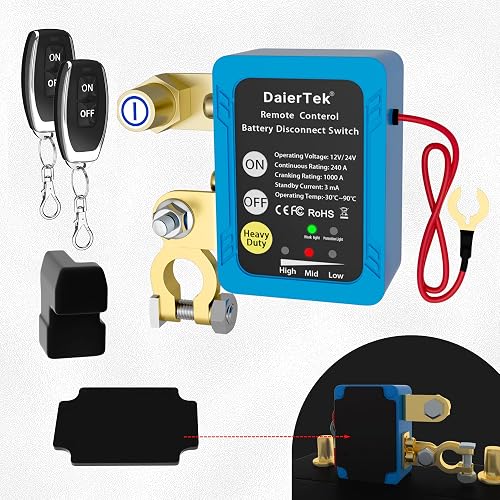 |  |  |  |  |  |  |
|---|---|---|---|---|---|---|---|---|---|---|
| Product | Remote Battery Disconnect Switch 12V | 250A Smart Remote Disconnect | DaierTek 300A Disconnect | DaierTek 240A Disconnect | 240A Disconnect with LED | Mini Relay Remote Switch | VONVOFF 30A AC Switch | Wireless 30A DC Switch | APP Control Disconnect Switch | VONVOFF 30A Relay Switch |
| Brand | DZSSCY | Ponzkoe | DAIERTEK | DAIERTEK | MaySpare | Meskliu | donjon | QOFOWIN | RIEIEK | donjon |
| Best for | Best Overall | Best for One-Click Cutoff | Best for Low Voltage | Best for 24V Systems | — | Best for Tight Spaces | Best for AC Mains | — | Best for App Control | Best for Two Remotes |
| The listing says | Remote switch prevents battery drain and protects circuit Rated current up to 250A, instantaneous current up to 450A | Upgraded heavy duty 250A, cut power with one click Remote and manual ON/OFF control modes | Installs on the positive terminal with a negative sensing wire Disconnects power when voltage drops below safe levels | Works with both 12V and 24V systems Remote disabled below DC11.8V/23V or above DC13.2V/25V | Cuts power after 120s below 11.8V Remote disabled above 13.2V for safety | RF signal works through walls and doors Max range up to 328ft with no obstacle | Receiver adopts 30A relay, max load 30A RF signal passes through walls, floors and doors | Uses 30A relay for high-power appliances Install the RF switch between device and power supply | Fits 12V-24V systems, input 6V to 30V Standby current only 0.6mA at 12V input | Receiver adopts 40A relay RF signal passes through walls, floors and doors |
| More information | Check Price on Amazon | Check Price on Amazon | Check Price on Amazon | Check Price on Amazon | Check Price on Amazon | Check Price on Amazon | Check Price on Amazon | Check Price on Amazon | Check Price on Amazon | Check Price on Amazon |
1. DZSSCY Remote Battery Disconnect Switch 12V
Avoids the trap of: undersized current rating for the job
DZSSCY’s listing leads with protection, and the numbers back the pitch: 450A instantaneous and 250A rated current. That gap between the two figures is the point – the higher number is what carries a starting surge, while the rated figure covers normal running loads. For a car, truck, RV or camper with a 12V battery, that spread gives you headroom a weaker switch won’t.
The install story is where this one earns its spot. It disconnects the negative side, clamps to the negative post, and runs a single red wire to positive. The seller notes the upgraded version drops a black power cord, which simplifies the wiring compared to earlier designs. It suits someone who wants a straightforward anti-theft and battery-drain solution without a screen or an app. This isn’t for you if you need 24V support or app control – the listing is a 12V unit, and it says.
Pros
- 450A instantaneous, 250A rated current
- Single red wire to positive simplifies install
- Fits cars, trucks, RVs, campers, motorcycles
Cons
- Listing warns disconnecting the positive terminal may damage the battery and circuit
2. 250A Smart Remote Battery Disconnect Switch 12V 24V
Avoids the trap of: a remote that fires while you’re driving
Ponzkoe builds this one around a smart voltage guardian. In smart mode, if voltage drops below 11.4V, the remote function shuts off to prevent accidental power cuts. The switch runs normally between 11.4-14V or 23-27V, and it handles both 12V and 24V systems. That automatic lockout is the feature that keeps a remote from killing power at the wrong moment.
The dual control stands out too. You get the keychain remote for daily use and a manual ON/OFF button on the unit itself, with five green LEDs confirming each action. Standby current is listed at 0.7mA, well under the 65mA the seller compares it to for a vehicle’s own draw. The trade-off is fitment: it only fits post diameters of 15-17mm, tapered, and the seller warns against industrial equipment. If your posts fall outside that range, this isn’t your switch.
Pros
- Remote disabled below 11.4V to prevent accidental shutdown
- 0.7mA standby current
- 12V and 24V compatible
Cons
- Only fits 15-17mm tapered posts
- Listing states it shouldn’t be used on industrial equipment
3. DaierTek Positive Terminal Battery Disconnect Switch 12V/24V 300A
DaierTek takes a different route than most: this switch installs on the positive terminal, paired with a dedicated negative sensing wire for voltage monitoring. The seller frames that as more accurate than traditional negative-terminal designs. It’s rated for 300A continuous and 1000A cranking, which is the highest cranking figure on this list, and it auto-detects 12V or 24V with no manual setup.
The safety logic is the reason it tops the list. When charging voltage passes 13.2V on a 12V system, or 25V on 24V, the remote function disables itself so you can’t cut power while the engine runs. A magnetic latching relay keeps standby draw at 3mA, using power only when switching. You get two remotes and a manual ON/OFF option. If you want a simple negative-post clamp and nothing else, this one’s positive-terminal design and sensing wire add steps you didn’t ask for.
Pros
- 300A continuous, 1000A cranking current
- Remote disabled above 13.2V/25V while charging
- 3mA standby with magnetic latching relay
Cons
- Positive-terminal install plus sensing wire adds wiring steps
4. DaierTek Remote Battery Disconnect Switch 12V/24V 240A Kill Switch Automotive
Avoids the trap of: buying a switch rated below your starter draw
This DaierTek runs 240A and covers both 12V and 24V, with the chip inside detecting which system it’s on once powered. The behavior is worth reading closely: connect it at 12V and it treats 12V as standard; raise the voltage to 24V and it reads that as “High” for a 12V system rather than “Mid” for 24V. That mode holds until you shut it down and power it again.
The alert system is the standout. A “Low” indicator lights below 11.8V/23V and an alarm sounds after 60 seconds; “Mid” stays lit in the normal range; “High” lights above 13.3V/25V. If voltage stays low for more than two minutes, the switch cuts power on its own. The kit includes a battery clamp and connect stud, and the seller says no existing wires need cutting. This suits trucks, RVs and boats where you want visible status. If you’d rather have a plain on/off with no alarms, the indicator logic is more than you need.
Pros
- Visible Low, Mid and High voltage indicators with alarm
- Auto power-off after 2 minutes at low voltage
- No cutting existing wires, clamp and stud included
Cons
- Voltage mode locks until the unit is shut down and repowered
5. 240A Remote Battery Disconnect Switch 12V
Avoids the trap of: trusting a feature that does nothing for you
MaySpare pairs a 240A relay with an LED digital display that tracks voltage in real time, so you can read battery health at a glance instead of guessing. The remote range is listed at a hundred meters, with an upgraded RF antenna the seller says works through walls and enclosures. Two intelligent protections run alongside: power cuts automatically after 120 seconds below 11.8V, and the remote disables above 13.2V so you can’t shut down while driving.
The install uses a negative link method that preserves original wiring, and it fits standard negative poles at 9-13mm or 15-17mm. Copper pillars handle conductivity, and the housing carries an IP54 rating for marine and off-road use. It’s built for 12V vehicles with displacements under 4.0L and currents up to 240A. If you drive something larger, or your battery posts are non-standard, the seller’s own fitment note rules this one out.
Pros
- LED display shows real-time voltage
- 328ft range through walls and enclosures
- IP54 waterproof casing for marine and off-road
Cons
- Optimized for 12V vehicles under 4.0L displacement
- Not compatible with small or non-standard battery post heads
6. Meskliu Mini Relay Remote Switch
Avoids the trap of: buying the wrong version of it
This isn’t a battery disconnect – it’s a small relay switch for low-voltage circuits, and that’s exactly why it’s here. The receiver measures 2.2 by 4 by 2.5cm, so it fits into a canopy, junction box or electrical box where a full battery cutoff never would. The RF signal is listed at up to 328 feet with no obstacle, working through walls and doors.
Wiring is direct: mount the receiver between the device and its power supply, then switch it from the remote panel. The listing names mud pumps, motors, lamps, fans, dust collectors, sprayers and car washers as uses. There’s a switch key on the relay itself, so a lost remote doesn’t lock you out. It runs at 10A, which is a circuit-level rating, not a starter rating. If you need to cut a car battery, this is the wrong tool – and the listing doesn’t pretend otherwise.
Pros
- Compact 2.2 x 4 x 2.5cm receiver fits tight spaces
- Switch key on the relay works if the remote is lost
- One remote can mount on a plate base like a wall switch
Cons
- 10A rating suits circuits, not battery-level current
7. donjon VONVOFF 30A AC Switch
This one is for AC mains, not vehicles, and the voltage range makes that clear: AC 110V, 120V and 240V. The receiver uses a 30A relay for high-power appliances, and the seller caps the load at 30A. The RF signal passes through walls, floors and doors, with a maximum range listed at 328 feet with no obstacle.
Setup is genuinely simple. The remote comes factory pre-paired, so there’s no programming after delivery – just wiring. No app and no WiFi are needed. It supports multiple remotes learning to one switch, or one remote controlling several switches, and offers three working modes: point movement, self-locking and interlocking, with interlock as the default. The listing names lamps, electric doors, windows, gates and industrial control as uses. If you’re looking to cut power on a car battery, this is the wrong category entirely.
Pros
- Factory pre-paired remote, no programming needed
- 30A relay for high-power AC appliances
- Multiple remotes can learn to one switch
Cons
- AC mains only, not for vehicle battery systems
8. QOFOWIN Wireless 30A DC Switch
Avoids the trap of: the compromise that gets returned in a week
QOFOWIN’s switch runs DC 12V, 24V, 48V and 72V with a 30A relay, which covers a wider DC range than most vehicle-specific units here. It uses a 433MHz signal the seller says penetrates floors and doors, with a maximum range of 328 feet. Installation is a matter of placing the receiver between the device and its power supply – no app, no network.
The relay has three modes: point dynamic, self-locking and interlock, with interlock as the factory default. A learning button lets you delete an old code and pair a new one, so a lost remote can be replaced rather than ending the whole unit. The listing names lighting, motors, lamps, fans, dust collectors and security alarms as applications. It’s a control-circuit switch, not a battery disconnect, so a starter’s cranking current is outside what the 30A rating covers.
Pros
- Wide DC range: 12V, 24V, 48V and 72V
- Learning button lets you re-pair a new remote
- Three modes: point dynamic, self-locking, interlock
Cons
- 30A relay suits control circuits, not starter current
9. 12V Universal Remote & APP Control Battery Disconnect Switch
RIEIEK adds app control to the mix. The unit works with 12V-24V systems, input from 6V to 30V, with 320A rated current and 860A instantaneous surge. Standby draw is listed at 0.6mA at 12V. You can power up by remote or by Bluetooth proximity, and the app lets you set the low-voltage cutoff point for 12V or 24V. A color screen shows battery voltage and switch status in real time.
The protection logic is thorough. Power disconnects when voltage drops below your preset value, and the cutoff is locked when voltage passes 13.7V/27.4V or when vehicle vibration is detected – both aimed at preventing an accidental shutdown while driving. A motor-driven relay with a dual-contact structure handles vibration resistance. The fitment note matters: the included clamp and terminal fit a 0.66 inch negative post only, so other sizes need extra parts. If you don’t want to manage a phone app, this is more complexity than you need.
Pros
- App-adjustable low-voltage cutoff for 12V or 24V
- 320A rated, 860A instantaneous surge
- Power disconnection locked above 13.7V/27.4V or on vibration
Cons
- Included clamp and terminal fit a 0.66 inch negative post only
- Extra clamps needed for positive pole or other post sizes
10. donjon VONVOFF 30A Relay Switch
Avoids the trap of: the wiring detail the listing buries
This VONVOFF covers DC 12V through 72V and lists a 40A relay in the specs, which is a step up from the 30A figure the same brand’s AC model carries. The RF signal passes through walls, floors and doors, with a maximum range of 328 feet with no obstacle. It’s aimed at industrial control and security uses: lights, motors, wireless alarms and door alarms.
Two remotes come in the box, which the seller frames as more flexible use. Multiple remotes can learn to one receiver, and one remote can control several switches. Like the AC version, it arrives factory pre-paired – no app, no WiFi, no programming after delivery, just wiring. It’s a relay for equipment circuits, not a battery cutoff, so don’t expect it to carry a starter. For a pump, a lamp bank or a security circuit, the heavy-duty rating and dual remotes do the job.
Pros
- 40A relay for equipment circuits
- Two remotes included for flexible use
- Factory pre-paired, no app or WiFi needed
Cons
- Not a battery disconnect, so it won’t carry starter current
Also Worth Considering
Three more listings came close. The Remote Battery Disconnect Switch at 200A is listed for anti-theft and automatic power shut-off for cars, ATVs and trucks, but its lower rating puts it behind the stronger picks for larger engines. A second Remote Battery Disconnect Switch, this one at 240A, is listed with a protect cover and voltage protection to prevent drain. The Nilight Remote Battery Disconnect Switch is listed as 12V at 200A, though the listing gives less detail than the ones above. Any of the three could work, depending on your vehicle and how much information you need before buying.
Before You Order
- Measure your battery post diameter and confirm it falls inside the switch’s stated fitment range before buying.
- Check whether your vehicle is 12V or 24V, and confirm the switch detects or supports that voltage.
- Find your starter’s cranking demand, then compare it to the switch’s cranking or instantaneous rating, not just its continuous figure.
- Decide whether you want negative-terminal or positive-terminal install, and read the seller’s warning about the one your vehicle uses.
Frequently Asked Questions
Is the simplest switch on this list enough?
For many drivers, yes. If you want a basic anti-theft cutoff on a 12V car with standard posts, a straightforward negative-terminal unit covers it. The DZSSCY Remote Battery Disconnect Switch 12V runs a single red wire to positive and handles 450A instantaneous, which suits a normal starting load. If you don’t need app control or a color screen, the simpler switch does the same core job.
What if it turns out to be the wrong one?
The most common mismatch is fitment, not function. Several switches here only clamp onto a specific post diameter range, and a switch that won’t mount is an immediate return. The second mismatch is current rating: a unit rated for a control circuit won’t carry a starter. Before ordering, measure your posts and confirm your system voltage.
What gives out or runs out first?
The battery itself is usually the first thing to suffer, and that’s the problem these switches exist to solve. A parked car with parasitic loads can drain over weeks, which is why low standby current matters – the listings here range from 0.6mA to 3mA, against the 65mA a vehicle’s own electronics can draw. Some units include two remotes, and some have a learning button or manual switch so a lost remote doesn’t strand you.
Which trap catches most people twice?
The voltage lockout catches people twice: once when the remote won’t work while driving, and again when it won’t work on a deeply drained battery. This is by design. On a 12V system, the remote disables above roughly 13.2V while charging, and some units also stop remote function below a low threshold – Ponzkoe’s listing, for example, disables remote control below 11.4V and won’t function at all under 6.5V. The manual button usually still works.
Closing
The trap that’s hardest to undo is a switch that cuts power while you’re driving, and it catches buyers who never read the voltage lockout line. Every good pick here disables its remote above a charging threshold for exactly that reason. Start by measuring your battery posts and confirming your system voltage, then match those two facts to the switch you choose.
Related posts:
 7 Best Portable Air Compressor for Car Tires: Top Picks Reviewed
 Best All Terrain Truck Tires for Towing: Ultimate Durability and Performance
 5 Best Tire Inflator for Truck Tires: Top Heavy-Duty Picks for 2025
 Best Fuel Tank Cleaner for Removing Sludge and Varnish Efficiently
 Best Gas Fuel Injector Cleaner: Top Picks to Boost Engine Performance
 Best Brake Pads for Trucks: Top Picks for Heavy-Duty Performance
 Best Automotive Air Compressor: Top 5 Tire Inflators for Your Vehicle
 Best Automotive Buffer for Flawless Car Detailing and Polishing
 Best Automotive Bug And Tar Remover: Top 5 Picks for Spotless Cars
 Best Automotive Water Spot Remover for Cars, Trucks, RVs & More